Advanced Assessment with IVUS, FFR and iFR
Coronary angiography provides an important visual assessment of coronary arteries. However, selected coronary lesions may require additional information before or during treatment.
Dr. Rohan Ainchwar provides advanced coronary assessment using Intravascular Ultrasound (IVUS), Fractional Flow Reserve (FFR) and instantaneous wave-free ratio (iFR).
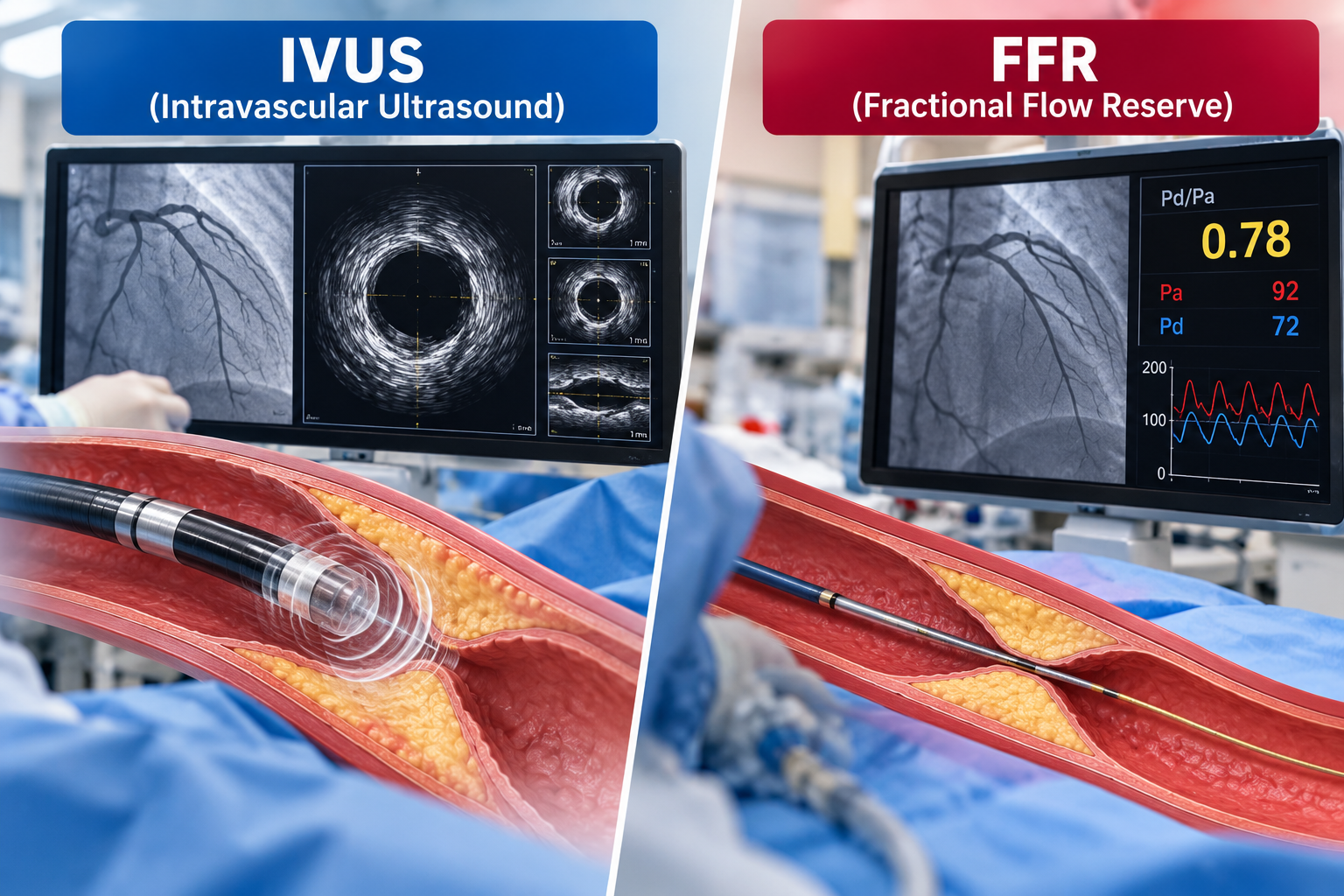
Intravascular Ultrasound – IVUS
IVUS uses a miniature ultrasound probe positioned inside the coronary artery.
It provides detailed images from within the blood vessel and can give additional information about:
- Vessel dimensions
- Characteristics of the coronary lesion
- Plaque and vessel structure
- Selected aspects of stent placement and expansion
Dr. Ainchwar’s resume also documents academic research involving the evaluation of stent expansion and recoil using IVUS, reflecting his academic exposure to this technology.
Fractional Flow Reserve – FFR
FFR provides physiological information about selected coronary artery narrowings.
It can help assess whether a narrowing is significantly affecting blood flow rather than relying only on its visual appearance during angiography.
iFR
iFR is another physiological assessment used to evaluate the functional significance of selected coronary lesions.
Supporting Treatment Planning
IVUS, FFR and iFR may support decisions regarding:
- Whether selected coronary lesions require intervention
- Planning coronary angioplasty
- Understanding coronary anatomy more precisely
- Assessing selected intermediate lesions
- Optimizing selected coronary interventions
These technologies are not required for every patient undergoing coronary angiography or angioplasty.
Their use depends on the characteristics of the coronary lesion, angiography findings and clinical situation.
By combining conventional angiography with advanced coronary imaging and physiological assessment where appropriate, Dr. Ainchwar can obtain additional information to support individualized interventional treatment planning.